


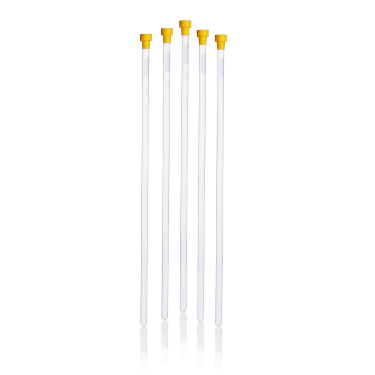
Tailor your NMR spectroscopy sample containment to your needs, by choosing from DWK’s KIMBLE® and DURAN® NMR tubes. DWK offers a range of grades and seals, all manufactured with quality you can trust, to ensure you have access to the ideal tube for your research.
- Tubes designed for use with NMR spectrometers.
- Specialty NMR tubes are available threaded, valved, sealed off, and RAY-SORB® processed.
- Available in KIMAX-HQ, thrift-grade, disposable-grade, and specialty tubes.
- Manufactured from 3.3 or 5.1 expansion borosilicate glass.
- Our NMR tubes are the industry standard 5mm in diameter and 178 mm long. Other diameter and length options are available as well.
NMR Tubes
Frequently Asked Questions
NMR tubes are used to hold NMR sample liquid within the magnetic field for NMR analysis.
NMR tubes can come in various materials, grades, and seals to meet your research needs. At DWK we offer NMR tubes manufactured from 3.3 or 5.1 expansion borosilicate glass, available in KIMAX-HQ, thrift-grade, and disposable grade. As well as specialty tubes, including threaded, valved, sealed off, and RAY-SORB® processed.
A typical NMR tube has an industry standard size of 5mm in diameter and 175mm in length. Custom NMR tubes in different diameters or lengths may be used for some specific applications.
Choosing an NMR tube depends on your NMR spectroscopy needs. The NMR spectrometer used will dictate some of the parameters needed for the tube, but the nature of the experiment also plays a role. For initial testing or high-throughput needs, a lower-grade NMR tube could be more appropriate and cost-effective, and higher-grade tubes should be chosen for experiments requiring greater sensitivity.
NMR tubes can sometimes be reused, but only if they remain free of scratches, cracks, or residues that could interfere with spectral accuracy. For high-sensitivity work or regulated environments, single-use or higher-grade tubes are often recommended to ensure reproducibility. DWK offers both reusable and disposable-grade options to suit different workflows.
NMR tubes should not be filled completely. The typical fill height is about 4–5 cm of sample solution, which is sufficient for the NMR spectrometer’s detection coil. Overfilling can affect shimming and spectral resolution, while underfilling may reduce sensitivity. Always follow your instrument’s guidelines for optimal sample preparation.